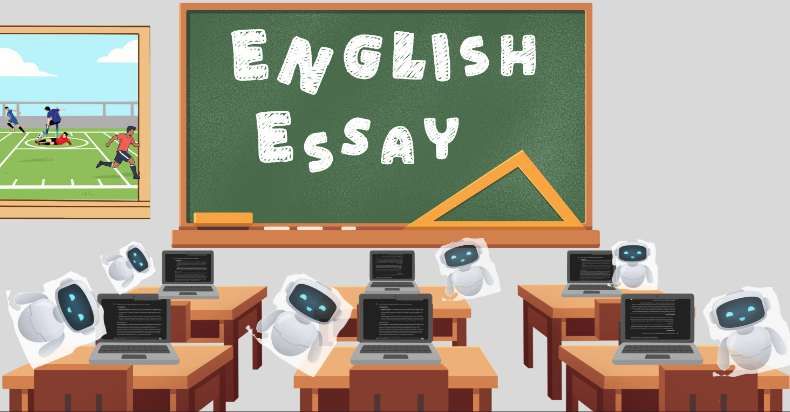
The second the bell for lunch rings is when I finally open the English doc. My cursor hovers over the blank document. Hours of free time last night, and I still didn’t start. I tell myself it’s fine; Artificial Intelligence can write an essay in the time it takes to finish my lunch. Why should I waste hours of my time when AI can do it in fifteen minutes at school?
I slide my lunchbox aside, and I start typing. Typing a prompt into AI to write, edit, and format an essay.
The use of AI has led me to believe that AI is both a blessing and a curse. AI has made it so that I can get many of my homework assignments done quicker but also makes me think I have more leeway when completing these assignments.
AI has made it easier to understand topics in every single one of my classes, and it has helped me when coming up with ideas for journalism.
Although AI has helped me, it is also incredibly detrimental to my sense of urgency to get things done. I became complacent with AI, especially when it came to writing assignments.
The creation of AI has changed the fundamental way people live, and although AI is a boon to humanity, I see it as a detriment to it.
AI is insidiously permeating every facet of human life. It perceives, generates, reasons, decides, and acts across digital and physical tasks. But the worry I have about AI is how it will affect the students.
Students are significantly impacted by AI in every task they are given, whether it is in math, science, English, or any other class/subject. For every class, you can just upload screenshots or downloads, and the AI will do it for you. Essay prompts, problem sets, data tables, and analyzing documents, and helping with Spanish. AI can work through it all.
According to the College Board, 79% – 84% of U.S. high school students used generative AI for schoolwork between January and May 2025. This staggering number shows how AI has started to impose on students’ creativity.
Kingsley Chan ’28 stated, “AI is a big help when it comes to homework, but I’ve started to procrastinate knowing I can use it.”
According to the Duke Center of Teaching and Learning, “Artificial Intelligence is increasingly integrated into critical thinking and decision-making across research, government, and industry.” AI has stagnated students’ growth in critical thinking and creativity.
AI stifles it all, as with it, students do not have to think as hard. An article by Duke says that AI can erode an individual’s critical thinking skills. The use of AI instills overreliance, speed, and “good enough” answers that make your brain stop doing the hard work. Carter Wells ’28 said, “I have tried to limit AI use, but I find myself thinking about using it whenever a problem is hard.”
The dangerous part isn’t just using AI, it’s the habit it builds if every hard assignment makes us immediately think, “I could just use AI,” our brains practice escaping effort instead of engaging with it.