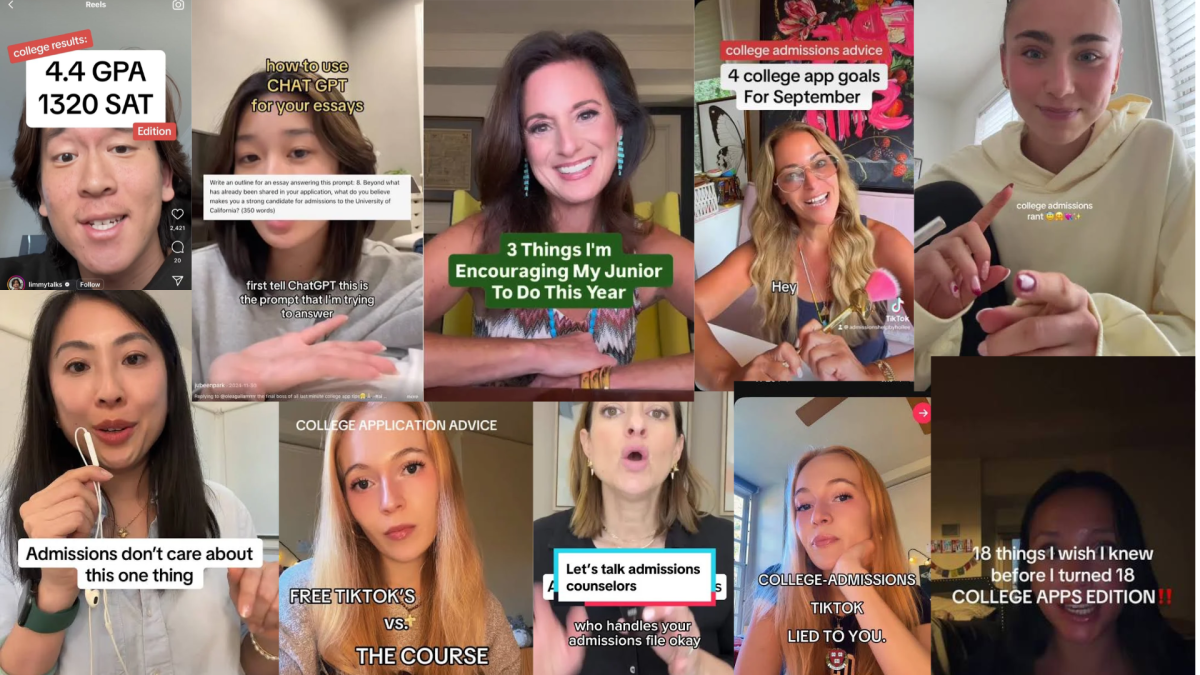
















In recent years, college admissions influencers’ online presence has begun to shape high school students’ expectations for college admissions. Online college admissions culture convinces students that only attending top-ranked colleges will lead to success.
Many seniors already feel this pressure. Aaditya Shah ’27 rated the stress of the application process “probably a seven or an eight,” mentioning the weight of essays, workload, and deciding where to apply early decision.
Many of the short-form videos students see include students getting into multiple top-ranked schools, which sets the standard for how students are judged, leading students to try to replicate the things that students did to make it happen.
Mr. Bryan Tomlinson, a college admissions counselor, said, “Not only can most students not do all the things that would be required to get into all eight Ivies, but most students kind of shouldn’t want to do those things, because your interests and background are different than that person’s.”
Mr. Tomlinson also points to another important source of this pressure, saying, “A lot of the time, the pressure on students is actually coming from what parents are seeing on social media.”
When parents see this content, they may think, “How can we get our kid to do the same?” This means that even if the student isn’t seeing this content, these fears can still trickle down from their parents.
Even students who know about this pressure are still affected. “A lot of the schools that I am applying to are T20s, mostly because of the reputation,” said Shah.
For Shah, the reason is practical. “I want to be a doctor, go into medicine, and a lot of opportunities are opened up by going to a highly ranked undergrad or highly ranked med school.”
Wanting to attend a prestigious college is not bad in itself; however, many students forget that there are many more colleges than they realize.
“For most students, their best-fit school is going to be a school that you have not heard of… Only by digging in and doing deep research are you going to find out that those schools even exist, let alone that they’re the best fit for you,” said Mr. Tomlinson.
Mr. Tomlinson explained that students who seek out advising can thrive anywhere.
“You could do that at a public school in Arizona and end up with really strong outcomes, either getting hired or going to grad school. And similarly, you could go to Harvard, assume that the name Harvard will carry you through, do nothing for four years except not get kicked out, and then not have that many opportunities when you graduate,” said Mr. Tomlinson.